
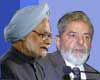
June 05: Today, as the World Environment Day is being observed, India and Brazil have expressed their concern of not sharing responsibilities by the developed countries for the climatic change and global warming, which is considered as a threat to the existence of the whole world.
In the ongoing visit of the Brazilian President, Luis Inácio Lula da Silva, the leaderships from both the countries have been discussing various issues related to economic, political, defense, science and technology, energy and environment, to strengthen bilateral relation between the two countries.
After a meeting between Indian Prime Minister, Manmohan Singh, and Brazilian President, Luis Inácio Lula da Silva, a joint statement was issued on Monday night, in which both the countries cited the unsustainable production and consumption patterns in developed countries as the prime reason behind the rapid climatic change. Both the countries have also indicated that they would not accept any such obligatory emission targets as it could hamper their economic growth.
Brazil and India are among the two developing countries that share common goals and a good regional and multilateral cooperation. Both are also the front runners for permanent seat of the United Nation Security Council and are going to participate in the up coming G8 Summit. In G8 summit, climatic change is expected to be one among the core issues and by the recent statement both countries have cleared it that solution for the environmental degradation due to the developed countries cannot be overlooked and the poverty in developing countries has to be considered.
The 23-points Red Fort Declaration also mentioned that developing countries can not acknowledge any approach that acts against its growth and poverty mitigation.
It seems to the understanding of India that U.S. and some other G8 members want to shift the environmental burden to China, India and Brazil - three most dominant developing countries. Though these countries have less emission rates compared to the developed countries but their rate of economic growth along with population has brought them into the lime light in the global climate change negotiations.
Brazil and India are committed to improve their trade ties along with cooperation in various fields including defense, space science, education, oil exploration. Japan and Germany are also in constant effort to make democratic set up in United Nation with an expanding membership with all as permanent members.
|
|






Comments: